Mario Merz Numeri – Codati da 1 a 987 (1975/1992)
Mario Merz’s work combines art, space, and energy to create a striking intervention in an architectural context, revealing underlying connections.
About the artwork
Key facts
Mario Merz
Numeri Codati da 1 a 987, 1975/1992
Neon, variable size
Letter Centre Zürich-Mülligen
Description of the artwork
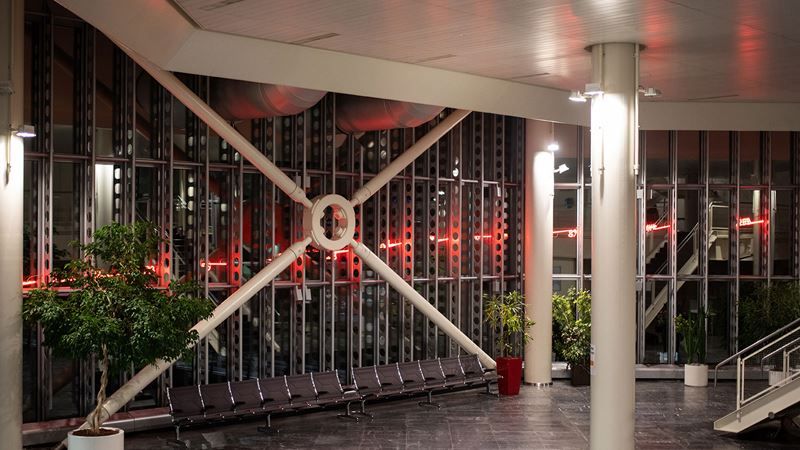
At night, red light beams through the windowfront of the Zurich-Mülligen letter centre. A total of 16 numbers formed with neon tubes can be seen in the entrance hall, visible even during the day: 1 – 1 – 2 – 3 – 5 – 8 – 13 – 21 – 34 – 55 – 89 – 144 – 233 – 377 – 610 – 987. With this light installation, the artist Mario Merz (1925, Milano–2003, Turin) refers to the Fibonacci sequence, in which each number is the sum of the two preceding ones. The shape of the neon numbers is based on the artist’s handwriting; each number has a tail.
Numeri Codati da 1 a 987 (Tailed Coded Numbers 1 to 987), created in 1975, was installed in 1992 and can be visited as part of a tour of the letter centre. Many of Mario Merz’s artistic works are integrated into existing architectures. It is therefore not surprising that this installation was already on view in a somewhat different arrangement in 1971 at the Guggenheim Museum in New York, under the title Fibonacci Progression. Thanks to the initiative and financial support of the architect Theo Hotz, the light installation was acquired through a Zurich gallery and moved to the Zurich-Mülligen letter centre. The work exudes innovation, individuality, and timelessness, just like the building, which is now a landmarked example of the technological, futuristic architecture of the 1980s.
About the person
Mario Merz
Mario Merz counts among the leading proponents of Arte Povera, an art movement that emerged in Italy in the 1960s. Arte Povera is known for its use of “poor” everyday materials and its critique of consumer society. From 1970 onwards, the Fibonacci sequence and neon light were recurring elements in Merz’s artistic work. For him, the sequence served as a universal model that could explain physical, biological, and sociopolitical phenomena. (JI)
Discover more artworks
Swiss Post’s Art in Architecture is diverse and closely connected to everyday life. Explore more artworks and artists from Swiss Post’s art programme.